


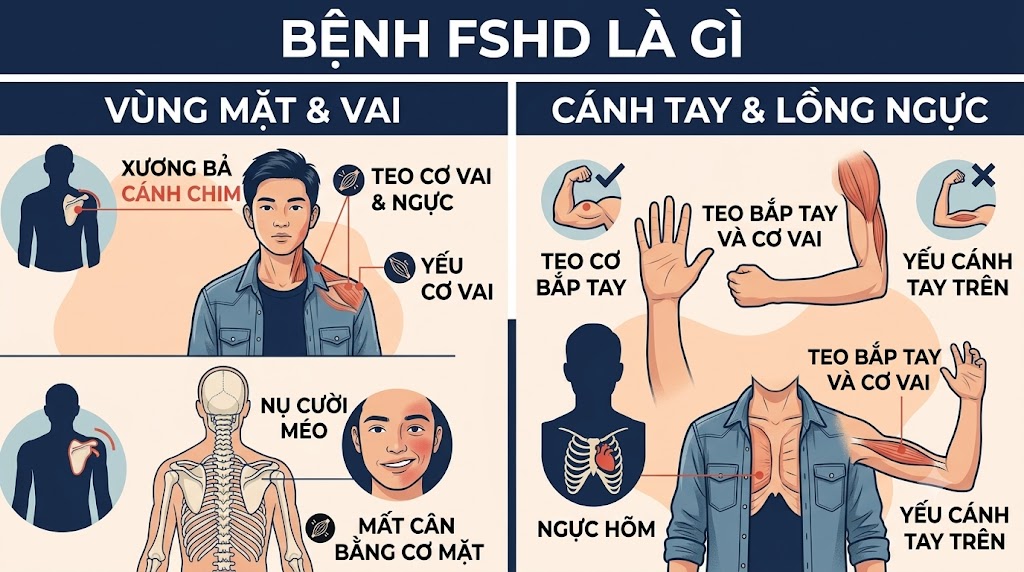
Facioscapulohumeral muscular dystrophy (abbreviated as FSHD) is a genetic disease belonging to the muscular dystrophy group, characterized by progressive muscle weakness and atrophy, mainly affecting the muscle groups of the face, shoulders/shoulder blades) and upper arms, with varying degrees and rates of progression among patients, even within the same family.
FSHD is a chronic, slowly progressive, non-communicable disease with diverse and heterogeneous clinical manifestations, affecting motor function as well as the patient's quality of life.
This disease was discovered in the 19th century, by two French doctors Landouzy and Derjerine, who published the first cases and recorded this special type of myopathy in 1885.
Muscular dystrophy is a general term for a syndrome of genetic diseases characterized by progressive muscle atrophy, degeneration and weakness, mainly caused by genetic abnormalities.
FSHD is one of nine types of muscular dystrophy.
FSHD is also divided into two types: FSHD1 and FSHD2, which are almost the same clinically and in terms of disease mechanism, only differing in genetic characteristics.
Most people with FSHD1.
Genetically, the disease is often related to structural abnormalities of the D4Z4 repeat region on chromosome 4 (FSHD1) or mutations in the SMCHD1 gene (FSHD2), leading to gene expression disorders and muscle damage.
FSHD1 type 1 accounts for about 95% of cases – due to shortening of the D4Z4 repeat on the chromosome.
Type 2 FSHD2 – accounting for about 5% – is related to mutations in the SMCHD1 gene, with clinical manifestations indistinguishable from FSHD1.
FSHD is a chronic, slowly progressive, non-communicable disease with diverse and heterogeneous clinical manifestations, affecting motor function as well as the patient's quality of life.
This disease was discovered in the 19th century, by two French doctors Landouzy and Derjerine, who published the first cases and recorded this special type of myopathy in 1885.
Muscular dystrophy is a general term for a syndrome of genetic diseases characterized by progressive muscle atrophy, degeneration and weakness, mainly caused by genetic abnormalities.
FSHD is one of nine types of muscular dystrophy.
FSHD is also divided into two types: FSHD1 and FSHD2, which are almost the same clinically and in terms of disease mechanism, only differing in genetic characteristics.
Most people with FSHD1.
Genetically, the disease is often related to structural abnormalities of the D4Z4 repeat region on chromosome 4 (FSHD1) or mutations in the SMCHD1 gene (FSHD2), leading to gene expression disorders and muscle damage.
FSHD1 type 1 accounts for about 95% of cases – due to shortening of the D4Z4 repeat on the chromosome.
Type 2 FSHD2 – accounting for about 5% – is related to mutations in the SMCHD1 gene, with clinical manifestations indistinguishable from FSHD1.
MyFSHD UNITED STATES
Dr. Research Center Jones Lab
Address: University of Nevada, Reno, Nevada, United States
FSHD VIETNAM
Ms. Flower
0768291089
nguyenhoa.dav@gmail.com
Ms. Kathy
kathyvn@gmail.com
CONTACT

Address: Hoan Kiem, Hanoi,
Vietnam
Vietnam