


FSHD causesMuscle weakness progresses over time, affecting daily activities.
Usually starts inadolescence or young adulthood, but it is possible:
Early onset (young children, ~5%)
Or very late (>50–60 years old)
Asymmetric muscle weaknessis a typical sign (one side is heavier than the other).
The disease progresses very differently in each person.
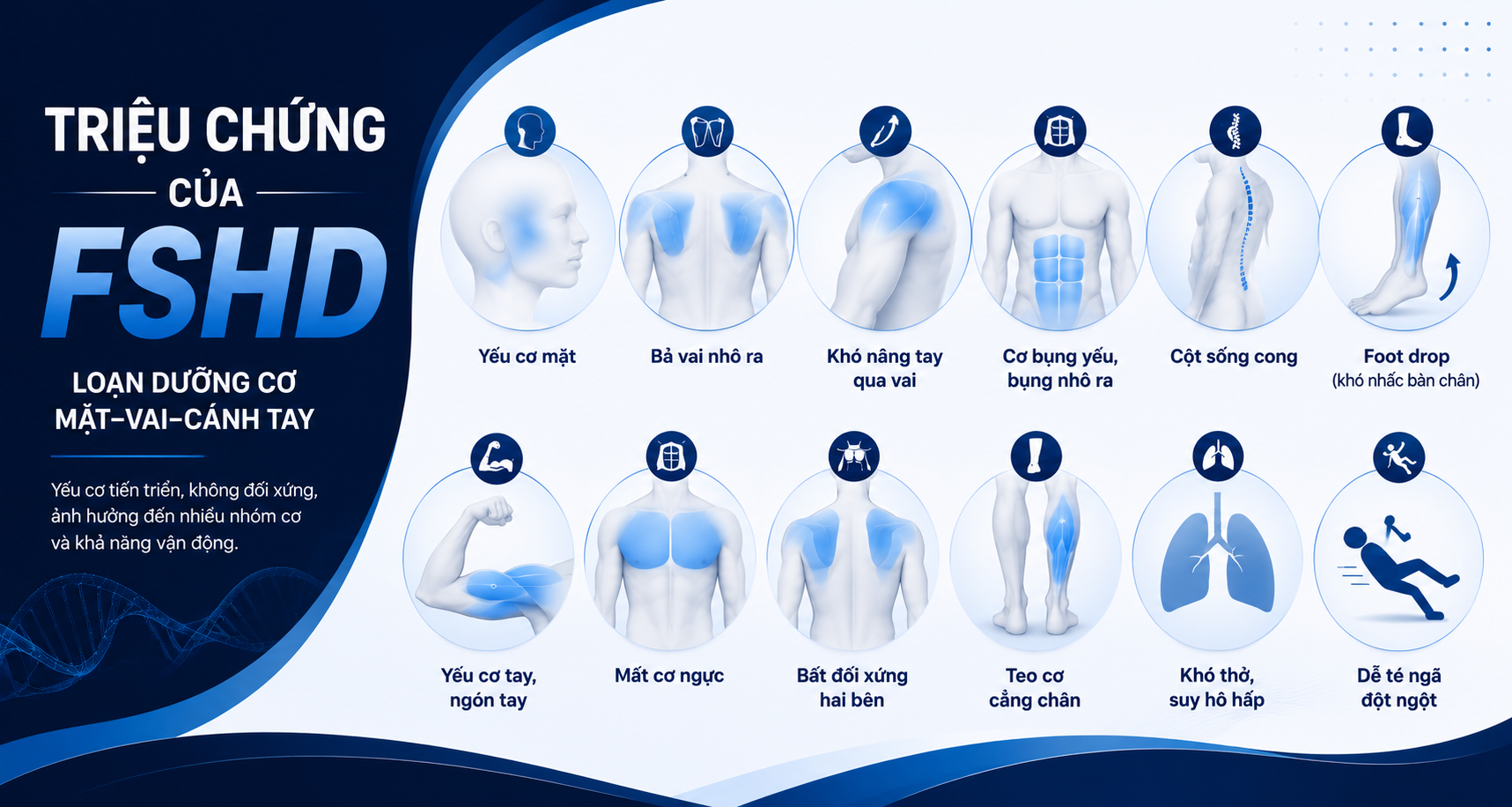
Group of facial symptoms
Difficulty whistling or blowing bubbles
Difficulty drinking with a straw
Do not close your eyes when sleeping
The mouth may deviate when at rest
👉 Due to muscle weakness around the eyes and mouth
Group of shoulder and hand symptoms
Scapular winging (scapular winging)
Difficulty raising arms over shoulders
Weakness in arms, hands, fingers
👉 You can clearly see the asymmetry between the two sides
Body symptom group
Weak abdominal muscles → belly protrudes like a “pregnant belly”
Loss of chest muscles, concave chest
Curved spine (arched, hunched, scoliotic)
Group of symptoms in the legs
Weak legs, easy to fall
Foot drops(feet droop, difficulty lifting feet)
👉 Makes walking difficult
Whole body symptoms
Prolonged fatigue
Muscle pain (may be burning, back, shoulder, neck, leg pain)
Reduced mobility
👉 Can significantly affect quality of life
Accompanying symptoms (less common)
Difficulty breathing/respiratory failure
Hearing loss (especially high frequency)
Coats disease (eyes, rare)
Mild arrhythmia (5–9%)
Progressive characteristics
Not all muscles are affected at the same time
Some muscles are weak, neighboring muscles are still normal
Progressunpredictable
Approx20% of patients may need a wheelchairlater
Usually starts inadolescence or young adulthood, but it is possible:
Early onset (young children, ~5%)
Or very late (>50–60 years old)
Asymmetric muscle weaknessis a typical sign (one side is heavier than the other).
The disease progresses very differently in each person.
Group of facial symptoms
Difficulty whistling or blowing bubbles
Difficulty drinking with a straw
Do not close your eyes when sleeping
The mouth may deviate when at rest
👉 Due to muscle weakness around the eyes and mouth
Group of shoulder and hand symptoms
Scapular winging (scapular winging)
Difficulty raising arms over shoulders
Weakness in arms, hands, fingers
👉 You can clearly see the asymmetry between the two sides
Body symptom group
Weak abdominal muscles → belly protrudes like a “pregnant belly”
Loss of chest muscles, concave chest
Curved spine (arched, hunched, scoliotic)
Group of symptoms in the legs
Weak legs, easy to fall
Foot drops(feet droop, difficulty lifting feet)
👉 Makes walking difficult
Whole body symptoms
Prolonged fatigue
Muscle pain (may be burning, back, shoulder, neck, leg pain)
Reduced mobility
👉 Can significantly affect quality of life
Accompanying symptoms (less common)
Difficulty breathing/respiratory failure
Hearing loss (especially high frequency)
Coats disease (eyes, rare)
Mild arrhythmia (5–9%)
Progressive characteristics
Not all muscles are affected at the same time
Some muscles are weak, neighboring muscles are still normal
Progressunpredictable
Approx20% of patients may need a wheelchairlater
General characteristics
Symptoms of Facial-Shoulder-Arm Muscular Dystrophy
MyFSHD UNITED STATES
Dr. Research Center Jones Lab
Address: University of Nevada, Reno, Nevada, United States
FSHD VIETNAM
Ms. Flower
0768291089
nguyenhoa.dav@gmail.com
Ms. Kathy
kathyvn@gmail.com
CONTACT

Address: Hoan Kiem, Hanoi,
Vietnam
Vietnam