


FSHD is a genetic myopathy caused byDUX4 gene expression disorderat chromosome region 4q35. The current unified pathogenesis is:
👉Abnormal expression of DUX4 protein in skeletal muscle cells → myotoxicity → progressive muscle degeneration
Role of the D4Z4 repeat region and the DUX4 gene
The D4Z4 region is repeating units (RU) on chromosome 4q35.
In normal people:
Number of iterations: 11–100 RU
Chromatin is in a heterochromatin state (heterochromatin) → inhibits DUX4 expression
In FSHD:
This structure is altered → disinhibition → DUX4 is expressed
FSHD type 1 (FSHD1) – mechanism due to D4Z4 contracture
Genetic causes
Shrink the number of D4Z4 repeats to:1–10 repeat units (RU)
Pathogenesis mechanism
- D4Z4 contraction →
- Reduce DNA methylation + open chromatin structure →
- DUX4 is aberrantly transcribed and translated in skeletal muscle
Consequences
- DUX4 is a toxic transcription factor
- Abnormal embryonic gene activation
- Causes oxidative stress
- Causes programmed muscle cell death
FSHD type 2 (FSHD2) – epigenetic mechanisms
Cause
There is no D4Z4 shrinkage
Have heterozygous gene mutations:SMCHD1(gene regulates chromatin structure)
Mechanism
- SMCHD1 mutation →
- Reduced methylation of the D4Z4 region (hypomethylation)→
- Open chromatin →
- DUX4 is aberrantly expressed
👉 This is the mechanism "digenic inheritance” (bifactorial inheritance)
Mechanism of muscle damage of DUX4
DUX4 protein causes disease through many mechanisms:
🔬 6.1. Direct toxicity on muscle cells
- Activate the embryonic gene program
- Causes loss of muscle differentiation
🔬 6.2. Causes cell death (apoptosis)
- Activation of cell death pathways
🔬 6.3. Immune disorders and inflammation
- Increased abnormal antigen expression
- Causes secondary immune response
🔬 6.4. Oxidative stress
Genetic characteristics
Genetic type:autosomal dominant
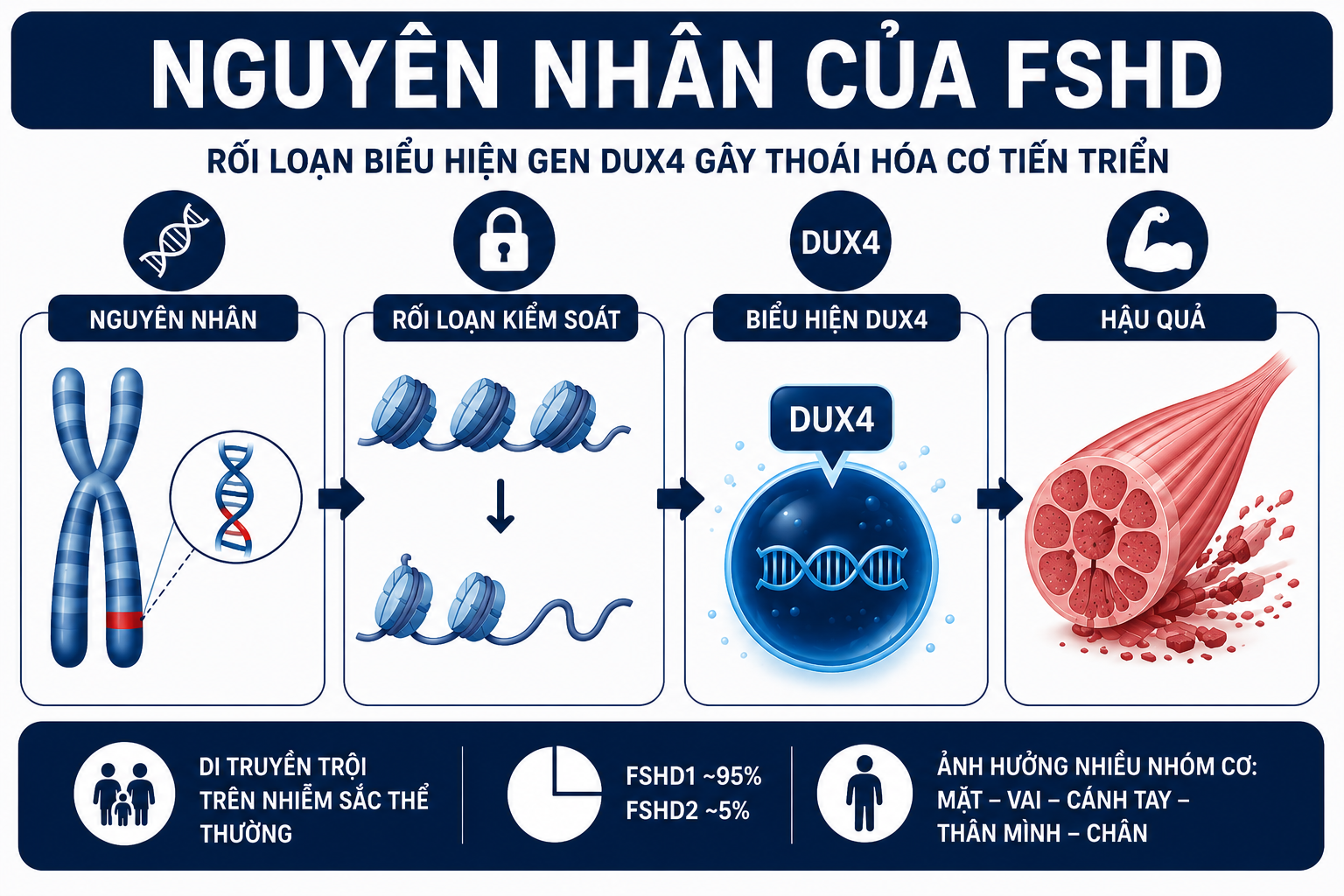
Mechanism of Facial-Shoulder-Arm Muscular Dystrophy
MyFSHD UNITED STATES
Dr. Research Center Jones Lab
Address: University of Nevada, Reno, Nevada, United States
FSHD VIETNAM
Ms. Flower
0768291089
nguyenhoa.dav@gmail.com
Ms. Kathy
kathyvn@gmail.com
CONTACT

Address: Hoan Kiem, Hanoi,
Vietnam
Vietnam